Your Personal Odyssey Modules
YOUR GUIDE TO MODULES
This guide will help you plan and schedule your work, and help ensure that you complete all required work in a module. It contains information on the following:
- The lengths of modules and due dates
- Requirements to complete a module
- Requirements to complete a repeated module or a custom module
- Videos in each module
THE LENGTHS OF MODULES AND DUE DATES
Below, you’ll find the dates when you’ll be starting a new module and when all the work for a module must be completed. You must complete six modules during the program session to graduate.
You are expected to turn in work throughout the time you are working on the module. Ideally, you should be turning in new work every day. Working regularly and intensely is how you will get the most out of the program.
You should not turn in a large clump of assignments on the final day of a module. The more work that is turned in on the final day, the less time your instructor will be able to spend reading each piece of work and discussing it with you.
Note: Your manuscript submissions have their own deadlines and are due by 8 AM ET on the dates listed in “Your Guide to Submissions.”
Note: Below, terms like “3rd module” indicate the third module that you choose to study, whichever one that is. The term “Module 3,” in contrast, is the title of the specific module focused on Character and Dialogue.
Work for a module must be turned in by 5 PM ET on the end date listed.
1st module: Monday, November 24, to Saturday, December 13
2nd module: Sunday, December 14, to Saturday, January 3
3rd module: Sunday, January 4, to Saturday, January 24
4th module: Sunday, January 25, to Saturday, February 14
[WINTER BREAK: Sunday, February 15, to Saturday, February 21]
5th module: Sunday, Sunday, February 22, to Saturday, March 14
6th module: Sunday, March 15 to Friday, April 3
REQUIREMENTS TO COMPLETE A MODULE
To complete a module, you must do the following:
- Watch the required videos
- For each video, complete a Video Reaction/Reflection
- Complete 5 journal entries
- Formulate with your instructor and complete an individual assignment
- Complete 2 critiques on the pieces provided
- Submit a story or novel excerpt no more than 6,000 words long with the Submission Attachment (see “Your Guide to Submissions” for more details)
- Meet with your instructor 3 times (4 times for the first module)
- Complete a Post-Critique Reflection
REQUIREMENTS TO COMPLETE A "REPEATED" MODULE
If you want to delve deeper into a particular topic, you have the option of “repeating” the module on that topic. Repeating a module doesn’t mean having twice the time to do the work above. Repeating a module means you first complete the module, as described above, and then you choose to explore that module topic more deeply by doing additional work. All new content will be provided that explores additional concepts and techniques to help you deepen your skills with that topic.
To complete a repeated module, you must do the following:
- Watch any videos that you didn’t watch the first time
- Watch/listen to/read new content added to the module (it may be necessary to buy a book)
- For each piece of new content, complete a New Content Reaction/Reflection
- Complete 2 journal entries
- Formulate with your instructor and complete a more extensive individual assignment or 3 regular individual assignments
- Complete 2 critiques on the pieces provided
- Submit a story or novel excerpt no more than 6,000 words long with the Submission Attachment
- Meet with your instructor 3 times
- Complete a Post-Critique Reflection
- (You may also want to review previously watched videos and other content if helpful)
REQUIREMENTS TO COMPLETE A CUSTOM MODULE
Students may request a custom module to study a topic that is not already the focus of a module. Requests should come several weeks before the module would start. If it is within our ability to provide the custom module, we will. The requirements to complete a custom module will be similar to those of a “repeated” module.
VIDEOS IN EACH MODULE
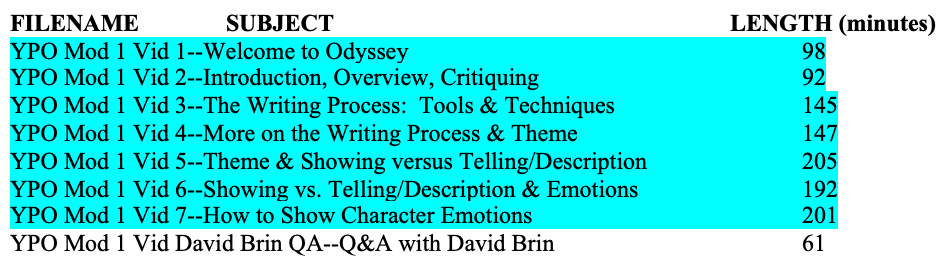
You should watch the required videos in the order listed below. The videos should appear in that order on Screencast, with the first video being in the upper left corner, the next video to the right of that, and so on. Watch any additional videos as time allows.
Note: Q&As involve guests answering questions from students and cover a wide range of topics.
Note: YPO = Your Personal Odyssey
Note: Required videos in each module are highlighted in blue.
Note: Each module has a document called “Connecting Handouts with Lectures” that will tell you which handouts are referenced in each lecture.
Required videos = 18 hours1
All videos = 21 hours 28 minutes
1In this module, you are required to view all the videos highlighted in blue. The others are optional, and you may watch them if time allows.
Description:
An introduction to the workshop. How having your work critiqued and critiquing the work of others can help you improve. How to critique, how to deal with having your work critiqued. The challenges you’ll face during Your Personal Odyssey. The need for deep practice. The eight elements of fiction.
Tools and techniques for prewriting, drafting, and revising. The effect your writing process has on your ultimate product. Changing your writing process to improve your writing. Creativity and problem solving.
Journal discussion on theme, which is covered more in Module 2.
Showing versus telling. The advantages of each. Significant details, strong details. How to make your fiction vivid and involving. Degrees of showing. Deciding when to show and when to tell. Description. Types of emotions evoked by fiction. Methods of conveying emotion. Emotional moments and techniques. Showing on the macro level.
Guest Lectures:
Fonda Lee on the revision process. Revision is where the magic happens; it’s how a shoddy first draft transforms into a compelling, resonant, polished finished story. This workshop will focus on breaking the revision process down into manageable chunks, auditing your draft for common issues, untangling your story’s problems, heightening its themes, and deepening its layers. We’ll also discuss how to effectively receive and incorporate feedback from critique partners and editors.
Required videos ~16 hours 12 minutes2
All videos = 22 hours 4 minutes
2In this module, you are required to view all the videos highlighted in blue plus two of the four guest lectures and two of the four Q&As highlighted in green, your choice.
Description:
Originality in genre fiction. Why is so much fantasy, science fiction, and horror so familiar? Why we need to understand genre. Discussion of genre analysis essays in the textbook. Developing your own ideas, your own sensibility. What is a story? What is the “truth” at the center of your story? Theme, countertheme, and premise. The importance of unity and how to use theme and premise to create a unified story or novel. Working within a genre. Tips and techniques for originality. Resonance and how to create it.
Journal discussion on outlining, which is covered more in Module 4.
The potential of setting. Worldview, storyview, and characterview. Developing a setting and world. Creating atmosphere and emotion. Common problems in setting and tips for overcoming them. Focusing your world around a magic system or novum. Techniques for including exposition while keeping the story moving ahead (which will be covered more in Module 4). Making your setting an integral part of the story. Choosing significant details while considering the point of view. When and how to include details. The connections between setting/world and plot, character, style, and theme. The strangeness budget.
Techniques for writing flash fiction.
Guest Lectures:
E. C. Ambrose on “Making It Real.” We often say that our task in writing fiction is to tell stories. In fact, what makes fiction sing is that it can convey an experience that the reader has never had, in a totally believable way. This is a special challenge for authors of speculative fiction. We need the reader to enter a new world, or to perceive the world around them in a new way. We need to do this as soon as possible, and with total clarity, so that the reader grasps the things that make our worlds unique, and gets excited to discover more. When a rich setting and distinctive character voice come together, they draw the reader in to explore the other aspects of your story. We’ll look at choosing or crafting the details of the story world and presenting them from the perspective of a unique character to make the story come to life.
Eric James Stone on making your science-fiction science believable. Eric will discuss how to come up with science fiction ideas and how to make them sound plausible. Where to research scientific concepts and how much research is enough. Getting the reader to trust your authorial voice. Avoiding—or disguising—the infodump. Distinguishing advanced technology from magic. Creating aliens that make evolutionary sense. How to break the laws of physics and get away with it. Continuing trends, converging technologies, and black swans.
Melissa Scott on worldbuilding as a foundation for story. Melissa will discuss worldbuilding as a springboard for character and plot, and the mechanics of revealing that world to your readers. She will cover methods for creating truly original worlds, as well as where and when to rely on the conventions of the genre. Research that doesn’t overwhelm yourself or your readers, exposition without lumps, and creating the illusion of large worlds in small spaces.
P. Djèlí Clarke on History, Speculative Fiction and Worldbuilding. Phenderson will discuss how history can influence speculative fiction in genres like fantasy, alternate history, and more, and how to utilize history in worldbuilding.

Required videos ~16 hours 18 minutes3
All videos = 21 hours 37 minutes
3In this module, you are required to view all the videos highlighted in blue plus one of the five guest lectures and one of the three Q&As highlighted in green, your choice.
Description:
Creating characters who are interesting, believable, and make us care. Tips and techniques for developing character. Common character weaknesses. The importance of a character’s goal. Figuring out your character’s emotions. Emotion arcs. Internal conflict. Externalizing internal conflict. The two types of character arcs. Character change. Character complexity and the Johari Window. The connection between character and plot.
Supporting characters who will help create a strong story. The adversarial ally and other character types.
The six methods of revealing character. Writing strong dialogue. Idiolect. Subtext in dialogue. Beats. Methods to increase tension in dialogue. Types of conversations. Oblique dialogue. Conflicts between the six methods of character presentation. How to make a strong protagonist.
Guest Lectures:
David Corbett on “From Helplessness to Habit: Backstory as Behavior.” Few problems generate more confusion or difficulty than how and where to use backstory—the facts of a character’s past that inform the present. In this two-hour presentation, award-winning author David Corbett (The Art of Character, The Compass of Character) will guide students in an extensive exploration of how to use moments from the character’s past defined by helplessness, both painful and promising, to develop the habits of behavior—pathological maneuvers and persistent virtues—that shape the character’s behavior and attitude toward life at the outset of the story. Those same moments of helplessness can be used to recognize the thematic longing at the heart of the character, from which her story can be built. Finally, the class will cover how to structure your story from the “misbegotten yearnings” and/or “mistaken desires” that so often result from how one responds to those earlier moments of helplessness, whether trying to protect oneself from the pain of life or hoping to pursue the promise of life.
Jeanne Cavelos provides a Special Topic Lecture on “Growing until You Can Acknowledge the Lie and Find Love,” an in-depth analysis of a complex character arc, that of Pat in the novel Silver Linings Playbook by Matthew Quick. Pat’s character arc combines growth and transformation.
Meagan Spooner on creating characters with substantial arcs. Meg will draw on her acting and theater background to discuss common character types in theater. She’ll explain how to find the right starting point for your protagonist’s arc, leaving room for the protagonist to change and grow. Setting up situations that prompt character change and then showing that change through the character’s altered reactions to events. Finding the right end point for the arc. How much character arc can you fit in a novel? How much in a short story? Arcs for supporting characters. Creating a point of view and voice that reflects the character’s change. Meg will take participants through the six-question method for developing a character.
Nisi Shawl on “Dialect and Representation.” Nisi will discuss marked categories and the unmarked state/dominant paradigm. Ways to depict marginalized peoples’ unique voices via dialogue. Arguably, everyone speaks in one dialect or another. But when characters’ speech patterns depart from standard forms, how can we reflect this on the page? We can show differences that enrich readers’ understanding of these characters and of our settings and stories. Or we can alienate our audience by drawing attention to dialogue in all the wrong ways. Examples, discussion, and exercises deepen students’ understanding of how to best represent nonstandard speech patterns.
Rebecca F. Kuang on character descriptions and physicality. Character description often feels like a rote checklist of features—eye color, hair color, height, build. How can we create vivid, memorable characters who remain in the reader’s imagination from their first meeting? How do you describe a character’s attributes without sounding like a DnD sheet, or a Bertillon report? I will discuss methods of describing characters by wedding physical and non-physical attributes in ways that not only help the reader see them clearly in their mind’s eye, but gain a better sense of what drives them, and what role they will play in the story.

Required videos ~15 hours 48 minutes4
All videos = 32 hours 42 minutes
4In this module, you are required to view all the videos highlighted in blue plus one of the seven guest lectures and one of the seven Q&As highlighted in green, your choice.
Description:
Making the journey from idea to story to plot. Generating a story statement from theme, countertheme, or premise. Creating conflict through goals and obstacles. Conflict at multiple levels. Connecting plot and character. Creating a plot that evokes emotion. The shape of your plot. Braided, mosaic, and collage plots.
Units of structure: scene, chapter, act. The requirements of each scene. One-act structure. Three-act structure. Analysis of structures in several stories from the textbook. Subplots.
Beginnings, middles, and ends. Exposition, escalation, suspense, pacing. The causal chain. Unintended consequences. The causal chain of character. Scenes and sequels (and prequels). Creating a strong climax that feels both surprising and inevitable. Epiphanies and character change. Resonance. Two types of revelations. The resolution or denouement. Plot tips. The overall emotion arc. Plotting for different lengths. The MICE Quotient.
Guest Lectures:
Barbara Ashford on creating compelling scenes. Barbara will discuss techniques to hook readers into every scene, create conflict that pushes the POV character forward on her journey, and craft a strong prompt that encourages readers to turn the page. Exercises and scene analysis will help students determine the inner and outer turning points of character change. Use turning points to calibrate pacing. Break down a scene into beats to focus on the emotional truth of every moment, pinpoint shifts in emotions, and explore ways to color emotions so that the actions and reactions of characters are not only clear, but vivid.
Brandon Sanderson on magic systems and how to tie them to plot, characterization, and worldbuilding. Brandon will discuss the stages of plot–promise, progress, payoff–and the dangers of misaligning these stages. He’ll also cover “Sanderson’s Laws,” four rules that help to create better magic systems, and how to innovate with worldbuilding. Internal and external consistency in magic systems. Finding the struggle in your plot; mental struggles, emotional struggles, flaws, costs. The advantages of going deeper rather than wider.
E. C. Ambrose on generating plot from the heart of your story. No plot, no problem! Or should that be, no problem, no plot? So often we get excited about an idea for a story—then we have trouble developing the actual *story* from that idea. We’ll brainstorm conflicts and complications based on your story seed, whether that’s character, concept or world-building, and talk about how to use those conflicts to develop a plot that will build toward a satisfying conclusion.
Gregory Ashe on using scene and sequel to structure your story, control pacing, provide character-driven momentum, and create clear goals, conflict, and struggle. Greg will talk about the elements of a scene, the elements of a sequel, and how well these clear-cut categories hold up (or break down) when the rubber meets the road.
Mary Robinette Kowal on the MICE Quotient. In this workshop, we learn about the organizational structure of the MICE Quotient, through which most stories (fictional or nonfictional) can be explained. Together, we learn how to make this structure work for you when writing. Mary provides additional insights into mystery structures and character arcs.
Nancy Kress on writing in scenes. Effective scenes are the building blocks of successful fiction. This workshop will discuss the various kinds of scenes, including the purposes and most effective placement of each type; the shape of successful scenes; and the elements that make a scene not only come alive but also determine the reader’s emotional reaction to the characters. Through both brief writing exercises and analysis of successful published scenes, the workshop will examine how strong scenes create tension, the engine that keeps readers turning pages. Discover key methods for improving your fiction!
Tim Waggoner on techniques for writing strong novels. Topics covered include novelistic scope, the action-idea, the inciting incident, classic plot design, plotting using scene and sequel, the spiral method of plotting, what to do if your plot starts to sag in the middle, advanced novel-writing techniques, and how to keep going for the long haul.

Required videos ~16 hours 4 minutes5
All videos = 17 hours 15 minutes
5In this module, you are required to view all the videos highlighted in blue plus one of videos highlighted in green, your choice.
Description:
Considering whether to make the viewpoint character, the protagonist, and the main character all the same character, three different characters, or something in between. The advantages and disadvantages of various points of view. Which viewpoints can work best in which types of stories. The effects point of view can have. Different types of first-person narration. The connection between point of view, voice, and style. Finding your story’s voice. Types of distance in point of view. How to minimize psychic distance. Developing a strong, consistent point of view. Common weaknesses in point of view.
The importance of making every paragraph, sentence, and word serve your story. Common stylistic weaknesses. Saying what you mean and meaning what you say. Writing unified sentences. Avoiding the phony archaic manner and other common pitfalls in fantastic writing. Techniques to strengthen style. How to emphasize certain words or sentences. How to make readers feel events through the rhythm of your sentences. Describing action. Using complex sentences to generate and convey emotion. Figurative language. Using sound to reinforce meaning. Developing a strong style suitable for your story and setting. How style can reinforce or undermine your novum. Learning and being inspired by others without copying others. How to create flow. Invented languages.
Guest Lecture:
Jeanne Cavelos provides a Special Topic Lecture on “Going Cold.” Jeanne discusses an unconventional way of evoking emotion in readers. We talk a lot about conveying emotions in a clear and powerful way, about making readers feel what the character is feeling, about bringing readers close to the protagonist, close to the viewpoint character. This can definitely create an emotional experience for readers. But is this always the best option? Some writers feel that going cold, being restrained in conveying character emotions, is an important strategy when emotions become intense, allowing a space for readers to participate, to imagine and create those emotions themselves. Jeanne explains this technique.

Required videos ~16 hours 52 minutes6
All videos = 19 hours 52 minutes
6In this module, you are required to view all the videos highlighted in blue plus two of the four guest lecture recordings highlighted in green, your choice.
Description:
Separating the writer person from the business person in your brain. How successful writers make sales and build a long-term career. Dealing with rejection. Secrets for publishing success. Understanding the book publishing industry and how book publishers think. The publisher’s list. Major trade publishers. Trends in publishing. What agents and editors are looking for.
Understanding the self-publishing marketplace. Traits of successful self-published authors. How to turn yourself into a self-publishing business. Should you self-publish? The pros and cons of various types of publication. Tips and warnings.
How to research and evaluate a book publisher or an agent. Qualities to look for in an agent. What an agent can do for you. Query letters, cover letters, synopses, sample chapters, author bios. What happens to your submission? Profit and loss statements. Review of sample novel contracts. Tips for novelists. Publicity and promotion.
Magazine and anthology markets for short fiction. Researching and evaluating markets. Understanding what magazine editors and publishers want. Trends in short fiction publishing. Dealing with rejections and trying to figure out what a rejection letter really means. How to respond to a request to revise and resubmit. Short fiction contracts.
Continuing your progress beyond this workshop and setting goals. How to remain productive. Reading your own material with a critical editor’s eye. Spotting your own weak areas and strengthening them. Controlling your internal editor. The race. Perseverance and being the hero of your own writing journey.
Guest Lectures:
Scott H. Andrews on “Short Fiction Publishing from the Other Side (Submissions, Slush, What Editors Are[n’t] Looking For, Rewrites, and Contracts), Story Openings, and Writing (and Life) as a Workshop Grad and Neo-Pro.” Scott will provide his best advice to writers submitting their work, dealing with rejections and revise and resubmit requests, and evaluating publishers’ contracts. What editors are hoping for each time they read a submission.
Sheree Renée Thomas on “The Short Story Writer’s Guide to the Multiverse: Three Ways Not to Get Rejected on the First Page.” What we should know by the end of page 2. Why your last line matters. Pacing and Prose. Nuts and Bolts–What to keep and cut in a cover letter. Standing out in the best way. Why some stories are rejected. The Secret Language of Editors: Decoding rejection letters. How to approach rewrite requests. Building professional relationships (fiction vs. journalism). Speculative Fiction is Literature. A World of Your Own: Editing anthologies and collections. Parallel Universes: Diversifying your writing portfolio. “Don’t Quit Your Day Job?” Careers in Publishing.
Steven Barnes on principles of success for writers. In an uplifting, energizing session, Steven presents an overall toolbox of the conceptual and psychological tools that he and his students have used to craft careers: not just plot and characterization, but breaking writer’s block, brainstorming, dealing with fear and depression, knowing when to retire a story, entering and maintaining flow state, making consistent progress on your journey to mastery, and much more.
