Q&A Excerpt: Carrie Vaughn
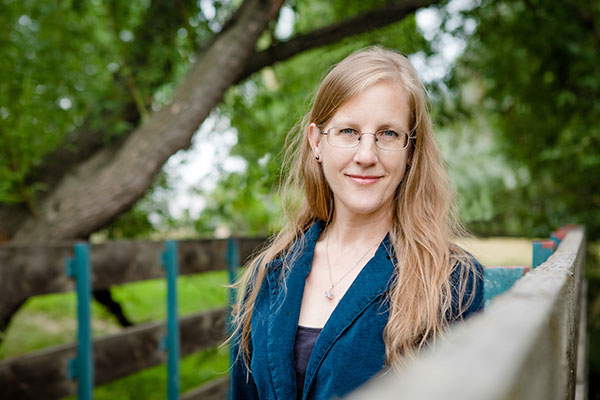
Carrie Vaughn was a 2024 guest lecturer for Your Personal Odyssey Writing Workshop. Carrie’s work includes the Philip K. Dick Award-winning novel Bannerless, a post-apocalyptic murder mystery; the New York Times Bestselling Kitty Norville urban fantasy series; over twenty novels and upwards of 100 short stories, two of which have been finalists for the Hugo Award. Her most recent novel, The Naturalist Society, tells the story of 19th century ornithologists, awkward love triangles, and the magic of binomial nomenclature. She’s a contributor to the Wild Cards series of shared world superhero books edited by George R. R. Martin and a graduate of the Odyssey Writing Workshop. An Air Force brat, she survived her nomadic childhood and managed to put down roots in Boulder, Colorado. Visit her at www.carrievaughn.com.
In this excerpt transcribed from a question and answer session, Carrie talks about how to know when you’re done revising and how to gauge when your work is good enough to submit.
QUESTION: One of the things that caught my interest was your take on revision. It seems like you have a multi-faceted approach, which probably spans from conception to the end, and I was wondering if you can explain it in a little bit more detail—what steps you take when you revise, what you’re thinking about when you’re revising, and how you know you’re done.
CV: Ah, the “how do you know you’re done” question. Usually I know I’m done when I’m just sick and tired of looking at it. That’s not a good answer. And it’s a little different for short stories and novels. For a short story, I’m looking for things like: Is the conflict there on the first page? Do we know who the characters are, or who the main character is? Is the arc clear? Is there a conflict? Is there an arc? That kind of thing. Especially with short stories, a lot of it is just really clarifying the language, making sure that the words say what I want them to say, if there’s anything unclear.
I don’t know if you all watched the reality show Face Off that was on the SyFy Channel for a long time. It was the movie makeup competition show, and every now and then—and granted they’re setting this up with editing—but you’d have an artist who would work and say, “Oh, I made a mistake here. Hopefully, they won’t see that.” They always see it. If you’re sitting there going, “Oh, this isn’t clear, this is a mistake, but hopefully nobody will notice that”—if I hear myself saying, “Oh, nobody will notice that,” I put a big circle around it, and I fix it. Because you gotta listen to your gut, right? So a lot of that is listening to my gut. It’s like, “Okay, this doesn’t quite make sense. Okay, circle it and figure out why it doesn’t make sense and make it better. I’m not quite sure why this character is doing that, or this character isn’t doing anything—maybe I need to cut them out.” So a lot of that is listening to those kinds of things.
For novels, like I said, I am constantly changing my mind. And rather than go back as soon as I change my mind about what a character is doing or what plot beat is important, instead of going back right then, I’ll usually kind of push forward and leave myself a note. It’s like, “Okay, go back. Change this scene. This scene is now just two people instead of three people and I’m gonna have to change everything.” Because what happens is, if I stop and go back and revise everything, then I’m probably just gonna have to do it over and over again, because I’ll change my mind about something else. So unless it’s something really huge that impacts the rest of the novel, I’ll just wait. So I’ll push through to the end, and then I’ll have the list of all of the changes I wanna make, and then go back to the beginning and make all those changes. And I’ll usually do that a couple of times before I actually print out the manuscript.
And I love being able to work on paper. I know a lot of people are getting away from that. A lot of people don’t do that at all anymore. But I see things on paper that I don’t see on the screen. But I’ll wait until I have the big plot beats and the big structure ironed out. And then I’ll print it all off, I’ll read it over, and even then I’ll find things like, “Oh, my God! This chapter is out of place. It needs to go two chapters later because it doesn’t set up the thing.”
The novel that’s coming out now, The Naturalist Society—the editor came back and said, “You know, these two plot beats, I think, are out of order. If we find out that they get to take the trip too early, then there’s no question that’s drawing the reader through.” So I ended up swapping two entire sections of the novel. It worked out well, but changes like that ripple out, and I had to go back and set things up a little differently, play things out a little differently. It raised a couple of more questions. And the editor was right. The tension ramped way up when I pushed answering that question back to the end of the book. But it did require moving around a lot of things.
I’m just kind of constantly thinking about it. And there’s a point where it’s like, I can’t do anything else, or I could do something else, but the brain just kind of shuts down. Particularly with short stories, though, I usually am pretty satisfied. I’ll get to a point where it’s like, “There’s nothing else I can do to this.”
To make it work with novels, I’ll get to a point where it’s like, “Yeah, I could do more to this, but that would actually change the novel. I could tweak this character a little bit, but then I would end up having to change a lot of other things.” Because with novels, every change you make ripples out, or it should. If everything’s connected the way it should be, then a change in chapter one should ripple out through the entire book. And you gotta be careful when you start doing that kind of thing. So yeah, there’s a point where it’s like, “Yeah, I could make changes, but it’s gonna change everything, and I don’t want to do that.”
QUESTION: In regards to short stories and when you’re sending out work, I’ve had many people tell me that you develop your own internal gauge for judging whether a work is good enough. If you’re sending out work and it’s coming back to you rejected, do you have any tips for developing that gauge of how to judge whether a work is good enough?
CV: It’s kind of the million-dollar question, right? Like, how do we know if this stuff is good enough? And that’s part of why we send it out, because we can’t judge.
So early on when I was first getting started, part of the reason I kept going is because I could see my writing getting better. I sent out my first couple of stories. They came back rejected because I was 16. I didn’t know what the hell I was doing. But interestingly, I got those stories back, and I looked at them, and I was like, “Oh, of course they rejected this. This is terrible. This new story that I just wrote is much better.” My writing was getting better from story to story to story, so at that point it was kind of easy, like “Oh, of course, this.” I didn’t know that before I sent them out. Of course, when I sent them out, I thought they were brilliant. But by the time they came back, and I had worked on other things, I could see, “Oh, no, this new thing is much better.”
That happened with my novels too. I tried to sell my first novel, and it didn’t sell. But by the time it came back, I had been working on the second novel, and I could tell it was so much better. And that just kept going.
So it got to a point where I got kind of fatalistic. It’s like, “Okay, well, this story is gonna suck by the time it comes back. I’m gonna see everything that’s wrong with it. But I’ll just send out the next one.” Until a very strange thing happened—one day a story came back rejected, and I did not understand why. I sat there looking at it, going, “But this is a good story. I like this story. I can’t see what’s wrong. Why did they reject it?” That was a turning point for me. And I think that happened right before I went to Odyssey. Part of the reason I went to Odyssey is because I had gotten to a point where my stories were getting rejected, and I didn’t understand why, because I thought they were good. I had sent out a lot of bad stories at that point, so I trusted my gut.
Connie Willis is kind of my personal guru. The question I ask myself a lot is, “What would Connie do?” And she has talked about a critical mass, that you’re actually writing good publishable stories for quite a while before you’ll actually sell one. It’s this strange phenomenon where your writing gets to that level, that publishable level, and you still have to keep going just a little bit further before you actually start selling. I’m not sure why that is. I suspect it’s a confidence skill, and conveying that in your prose.
So most of the time now—I’ve been doing this a long time, so most of the time I can look at a story and tell, “Okay, yeah, this is good. I know exactly where to send it. This editor is gonna like this story.”
I still write stories that I don’t send out. Occasionally I’ll write a story and think, “No, I don’t want to send this out. I don’t know what’s wrong with it, and I’m not interested in fixing it, so it’s just gonna go in the trunk.” Sometimes I’ll send a story out and it gets rejected a couple of times, and I trunk it because I can’t figure out what’s wrong with it. I had one just a couple of years ago that got rejected. It didn’t get rejected very much, only about three times, but at that point I was like, “You know what, I think they’re right. I think there’s something wrong with this story, and I don’t know what it is, and I’m working on too many other things to fix it.”
But yeah, it did get to a point where I didn’t understand anymore. And the thing about that is, you just have to keep going. You have to have a little bit of faith. Keep sending it out. I do not advocate revising a story every time it gets rejected because I think that way lies madness. Because sometimes getting rejected is just a matter of you hit the editor on the wrong day, or they just bought a story that was similar to yours. There are reasons other than the story itself for getting rejected, so you have to just gird your loins and go back into the fray and just keep pushing. It’s hard. It’s really hard.
NOTE: This transcript has been edited for clarity.
Discover more from Odyssey Writing Workshops
Subscribe to get the latest posts sent to your email.