Q&A Excerpt: Jill Tew
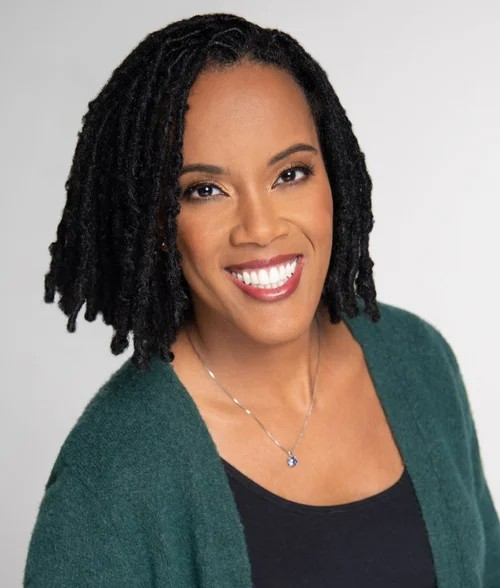
Jill Tew was a 2026 guest lecturer for the Your Personal Odyssey Writing Workshop. Jill is the award-winning, critically-acclaimed author of dystopian romance and middle grade novels that imagine Black girls in exciting new worlds.
Her debut novel The Dividing Sky (2024) was a Top 10 Kids Indie Next Pick and was selected by Kirkus, Publishers Weekly, Bookshop.org, and Reactor Magazine as one of the Best Young Adult Books of the Year. Her middle grade debut Kaya Morgan’s Crowning Achievement was released in April 2025, and she returns to her Young Adult roots in her latest novel, An Ocean Apart, published by Joy Revolution/Penguin Random House, which became the #1 new release on Amazon in Dystopian Fiction for Teens.
A graduate of the Wharton School at the University of Pennsylvania, Jill lives in Atlanta with her family. She is a graduate of Your Personal Odyssey and a co-host of the Afronauts Podcast, which provides writing tips and community for Black aspiring speculative fiction writers. When not writing, she can be found stress baking, gardening, or belting showtunes in the carpool line.
In this excerpt transcribed from a question-and-answer session, Jill talks about finding comparable titles for your novel and how she prioritizes her reading choices as a professional author.
QUESTION: I was wondering if you could speak to comps just a little bit. How do you find them? Do you just read a ton, or do you have other techniques to find comps? And then, how far back do you go, and do they all have to be within a specific genre, or the genre you’re writing in, or are you allowed to cross genres?
ANSWER: Yeah, that’s an awesome question. I think there are two different kinds of comps. I think there are industry comps, so for your agent or your editor. I think those have to be almost always books, almost always fairly recent, because they want to know that there is a real market audience that they could easily cross-sell to.
A lot of booksellers, I realized doing my pre-order campaign for my last YA, when they’re thinking about how to sell a book, sometimes they will just do a blast to readers of a similar book. And so, to be able to have a similar book in mind is really helpful on a practical level for booksellers or for editors, or for publishers who are going do a blast to readers of V. E. Schwab or readers of Veronica Roth. They need to be able to put you somewhere for people that are already reading. I think that’s because a lot of publishers only know how to talk to existing readers, and that’s fine.
So for those comps a lot of it is what I’ve read, or what I think has similar vibes based on what I’ve seen online. A lot of books I haven’t read that could be right—I’ll buy it, or borrow it from the library, skim it a little bit, be like, yep, checks the box, has similar gothic vibes, or similar love interest dynamics, or similar quirky voice or whatever. You don’t have to read the whole book if you don’t have time. You could; you might learn something. But a lot of it is just, can I reliably say that if you’re into the scrappy protagonist of XYZ that you will also find something to enjoy in my book? I have friends who read a lot, and sometimes I’ll just gut check with them. Does this book feel like a comp? And sometimes they’ll say yes or no.
That is the first category of comps. I think there’s another category of comps that will serve you better when you’re doing the social media, reader-facing part, even influencer-facing part, and that is to bring in people who maybe don’t read that much. I think a lot of the biggest sellers that I’ve seen recently, especially in the YA space, are attracting people who don’t think of themselves as readers but who want a similar experience to a show they’ve watched, or a movie they’ve seen, that they don’t know where to find again. So you’re saying, hey, if you liked Bonnie Bennett but you wish that she had had her own protagonist arc, read my book. And there are so many more of those people than there are of people who already read, so if you can get even a fragment of them to believe that your book will offer a similar experience, that’s huge.
And so for that, TV shows, songs, tropes. I have a friend whose book is coming out this August, it’s a thriller, and one of her comps is the I-choose-the-bear meme. That’s the comp for the book for people, not for booksellers, because we all know what that means. We all know the vibes you’re gonna get if that’s the comp for a book. So feel free to get creative. And again, the more creative you can be, the more niche, the more tapping into some sort of emotional resonance for those comps when you begin to do your reader-facing marketing, I think the better.
QUESTION: I’m just piggybacking on what everyone’s talking about with comps, and also … with managing your time, because this is all kind of new to me, and I’m totally intimidated by finding recent comps because I barely have time to write, let alone read all these books. So I was just wondering, for your own life, how do you do it with whatever time you have to read? Are your reading priorities different now? Are you reading more for the business side than for the leisure side?
ANSWER: For the first year I was a published author, I was reading whatever was the big book. I made a rule for myself after doing that, and not feeling fulfilled by that, that I was only going to read books that leveled up my game in some way. And there could be a million ways to define that. It doesn’t have to be a masterpiece of prose. But if there’s an author who does yearning extremely well, I will read that book to figure out how to do yearning really well. I will DNF [did not finish] if I’m starting a book and I’m not learning anything. And if I’m not entertained either, I’ll put it down. So DNF with reckless abandon, and be discerning with what you’re reading. I do a lot of audiobooks; if you’re busy and multitasking, doing the dishes, running errands, walking the dog, audiobooks really help. But even then, I’m not just reading. The hot new book came out, everyone’s reading it. Is that what I’m focused on right now? If that’s not what I’m working towards, I don’t need to do that, right? So that’s how I think about it. Am I learning something? Or, if I’m entertained, there’s something to be learned there, because I want to write entertaining books. This author is doing something right, and I’m having a good time. I want to figure out why I’m having a good time.
NOTE: This transcript has been edited for clarity.
Discover more from Odyssey Writing Workshops
Subscribe to get the latest posts sent to your email.