Graduate Essay: “Selling Your Shorts: Submission Considerations Amid a Changing Market” by A. Katherine Black (Part 2 of 2)

A. Katherine Black is a 2018 graduate of the Odyssey Writing Workshop and a 2024 graduate of the Your Personal Odyssey Writing Workshop. She’s served as Resident Supervisor for previous Odyssey Writing Workshop cohorts and has served as Moderator and Resident Supervisor at The Never-Ending Odyssey (TNEO), an annual workshop for Odyssey and Your Personal Odyssey graduates. She’s a member of SFWA and Codex.
A. Katherine has racked up nearly 600 rejections since 2018, and her stories have appeared in The Dark, Fractured Reveries by The Storied Imaginarium, OTHER by Bannister Press, Familiars by Zombies Need Brains, Cosmic Horror Monthly, and other publications.
A. Katherine lives in Minnesota with her family, cats, and coffee machines. She loves snowstorms, board games, and all kinds of creature flicks, but especially the ones where the creature is the good guy. Find her at flywithpigs.com or on Bluesky @akatherineblack.bsky.social.
The following essay was adapted from a lecture A. Katherine did for TNEO in 2025. Part 1 of this essay, posted last Monday, is available here.
A big topic of discussion recently within the speculative fiction community has been the acquisition of five well-known, long-running magazines by Must Read, Inc. (referred to by some writers as Must Read Magazines, or MRM): Asimov’s, Analog, Fantasy & Science Fiction, and both Alfred Hitchcock’s and Ellery Queen’s Mystery Magazines. Concerns about Must Read’s contracts came to the forefront thanks in part to a few authors sharing their experiences with their peers and the public, such as Kristine Kathryn Rusch and P. A. Cornell. The contract issue has been summarized in Jason Sanford’s Genre Grapevine and addressed by the Science Fiction and Fantasy Writers Association (SFWA) in theirJuly Market Report by David Steffen, in an Industry Alert posting in July, and in Writer Beware posts on Moral Rights and summarizing the contract controversy.
And the common message in the above posts and so many others by writers and editors in the short SFFH field? Scrutinize every single contract, even if you think a magazine has a glowing reputation, even if you’ve previously published in the same magazine.
As Kristine Kathryn Rusch puts it: “…I always treat contract negotiations as if the great people I love had been replaced by a demon. Would I be protected even if the people I knew left? That’s my guiding principle.”
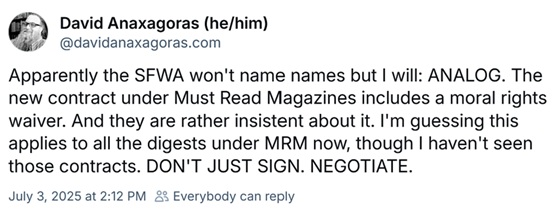
Or, as writer David Anaxagoras posted on Bluesky: “DON’T JUST SIGN. NEGOTIATE.”
What’s to negotiate, you ask? If you haven’t yet had the pleasure of reading a contract for a short story sale, I hope you have that pleasure in the future! Even if you have, a refresher may be helpful. Remember, this is your story, your art, going out into the world, and your rights as the creator are important!
Here are a few items you should expect in a short story contract:

The author’s name or pseudonym will be published along with the story.
A publication date or a time frame for publication is specified, along with a time frame after which the contract is void if the story isn’t published (i.e., if the story isn’t published within twelve months of the contract being signed, all rights revert back to the author).
The exact amount the author will be paid, the method in which the author will be paid, and the time frame in which the author will be paid (i.e., upon signing the contract, within a month of publication, etc.), and there is often a “kill fee” listed as well (i.e., a fee the author will be paid if the publisher decides not to publish the story after all).
The exact amount the author will be paid, the method in which the author will be paid, and the time frame in which the author will be paid (i.e., upon signing the contract, within a month of publication, etc.), and there is often a “kill fee” listed as well (i.e., a fee the author will be paid if the publisher decides not to publish the story after all).
A description of the publication rights granted to the publisher (i.e., “First World Publication Rights” might be listed if this is an as-of-yet unpublished story), including a time period after which those rights revert back to the author (often in three months, six months, or a year after publication, and often this is waived specifically if the story is selected for a “best of” anthology).
The right for the author to see and approve any edits before publication. Note that some contracts may indicate that the publication reserves the right to “make minor edits” without approval—as the term “minor edits” may be up for interpretation, this is a contract item some authors may choose to negotiate.
Contracts may also include:
That the author guarantees the story is their own work, and sometimes specifying that the author didn’t use LLM/AI tools in the process of creating the story.
That the publisher reserves the right to include the story in an anthology that contains other works previously published in said magazine, and/or in audio format on a podcast hosted by the publisher; in such a case, additional payment amounts and payment time frames should be noted.
Examples of red flags to keep a look out for in short story contracts, which aren’t in the writer’s best interest:

Lack of publication date/range or lack of reversion clause! Without at least one of these, a publisher could conceivably hold onto your story forever, without publishing it. If the market stipulates that payment doesn’t happen until publication, this could mean you’re never paid for that story, and if the rights to that story never revert back to you, you’re prevented from submitting that story for reprint at other markets, or even including it in your own short story collection in the future!
The publication tries to reserve the right to publish the story in future unnamed or undefined markets. This would potentially allow the publisher to place the story in other magazines or anthologies without consulting the author and without paying the author for the reprint. It should be the author’s choice where and when their story is printed and reprinted!
Any mention of the publisher reserving or “managing” film/TV rights and/or merchandising rights. These are key areas where an author should control how their Beloved Story is treated outside the realm of the printed word, and selling film and/or merchandising rights could even make the author enough money to pay that mortgage! Don’t sign those rights away!
To view a common short fiction publishing contract, see SFWA’s sample contract here, and additional information from the SFWA Contracts Committee is listed here.
If you see any red flags in a contract, if any of the standard items are missing from a contract, or if you, as the author, have any concerns about the wording of a contract, reach out to that publisher and negotiate! Tell them what you’re willing to agree to, what you’re not willing to agree to, and/or what contract items require clarification. And if you have any questions about a contract you receive, SFWA’s Contracts Committee invites you to reach out with your questions.
Publishing details and/or sample contracts are often listed on a publisher’s submission guidelines page as well—taking a look at those, when available, can save you from surprises and headaches down the road.
Okay, so we’ve talked about several recent market changes—but how do these impact Submission Tetris, again? Remember, it all depends on your personal priorities:

When it comes to changes in submission windows, with some magazines shifting to only one or two brief submission windows a year, for example, it’s up to you to decide how important it is to hold Beloved Story until Magazine A’s window opens, or to pull Beloved Story from the queue in Magazine B when Magazine A’s window opens unexpectedly. Is Magazine A your absolute dream market, or are you happy to have a story out there, no matter what market takes it?
One positive development is that more magazines are allowing for simultaneous submissions, meaning they’re okay with an author submitting Beloved Story to them and submitting the same Beloved Story to another magazine at the same time. Be sure to check a market’s submission guidelines page to find out if they allow for simultaneous submissions.
When it comes to magazines’ policies on the use of LLM/AI tools, you can choose to submit to those markets whose policies align with your personal opinion on the issue.
Similarly, you can choose to submit to magazines that have other policies or support specific topics that are also important to you—if you prefer to submit to magazines that read submissions anonymously, for example, or if you prefer to submit to magazines looking to promote climate awareness. Checking a magazine or anthology’s submission guidelines page will often explain a lot about their policies and their focus.
When it comes to contracts, including how much a market pays for your story, how long the market wishes to hold the rights for your story, and whether a market offers standard or non-standard contracts in general, again, consider your personal priorities. Maybe pay is high on your list because you’re saving up to buy that shiny new laptop, or maybe you’d like the rights to your story to revert back to you ASAP so you can begin submitting to other markets for reprint sooner and thus get your work out to as many markets as possible, for greater visibility.
Okay, great, you may be saying, so it’s all up to me… but who has the time to do all that research??? Between jobs, chores, family, and using those precious few spare moments to actually write a sentence or two, where do I find time to keep up with this shifting market with its random submission windows and legal and ethical controversies, let alone devise a new strategy for my Submission Tetris?
I agree—it’s a lot to follow.
Luckily for us, though, there are many awesome resources (many free of charge!) just waiting to help you sift through the issues and follow whatever submission plan fits you.
Some great resources to help you keep up with market changes are:

Locus Magazine offers a ton of SFFH industry news each month
SFWA offers resources for non-members, as well as members, including the above-mentioned Monthly Market Report
The Horror Writers Association (HWA) also offers resources for non-members, as well as members
Jason Sanford’s Genre Grapevine, as mentioned above, and his new GenAI Grapevine cover a number of important topics
Posts by Diabolical Plots often address current issues in the field, which are also reflected in the regularly updated market listings in the Submission Grinder, one of several submissions trackers available out there (see submission trackers below)
And learn from your peers! Search for speculative writing groups in your area, many of which can be found on Facebook or on Meetup.com, or consider online speculative writing groups such as Codex
Now a note on market searches and submission tracking…
There are several websites that offer the opportunity to search for open markets and to log and track your submissions (including short stories, flash, poetry, novelettes, and novellas), such as the Submission Grinder, Duotrope, Submittable, and Chill Subs. Some require paid subscriptions, others don’t. Some offer newsletters with market updates, including listings of markets soon to be opening for submissions, and offer options to search for markets based on specific criteria. For example, the Submission Grinder allows you to sort through markets based on whether they use standard or non-standard contracts (“standard contract” being one generally aligned with that listed on the SFWA site), whether they accept works created using LLM/AI tools, whether they charge a fee for submitting, story genre, pay rate per word, and more. Each of these tracking websites are slightly different, so it may be worth taking the time to peruse what each one offers so you can find the site that’s right for you.
The above resources can be extremely helpful as you customize your submission strategy, but beyond the market tracking sites and the industry organizations, it can also be helpful to follow publishers and editors through newsletters and social media.
Oh, but I can almost see your reaction through the screen. Am I really suggesting more newsletters clogging your inbox, and even more time on social media? Aren’t those the poisoned apples of a writer’s existence, the teetering edge of an eternal rabbit hole, the bricks that build the long, winding path of procrastination? Am I actually suggesting you sacrifice more of your valuable time to the scrolls of doom?
Uh, maybe? But only in moderation (she wrote, hopefully). Hear me out…
Many of us love going to writing conventions—or “cons” as we affectionally call them, right? I remember the first con I attended, the first panel discussions I listened to, the first awards ceremony speeches I heard in person. Finally being in a room filled with like-minded nerds was an awesome, if intimidating, experience! And frightening as they can sometimes be, cons offer great opportunities to meet the editors of those magazines and anthologies we adore, those magazines and anthologies we’d love to someday contribute to. But what if we can’t make it to the cons? What if our jobs, family schedules, and budgets don’t allow for such a luxury?
Now there are ways to get to know those editors from afar, as well as other like-minded writing nerds—ways that didn’t even exist when I attended my first con back in 2018.
Of course newsletters aren’t new—search your favorite magazine’s website, and you may find a newsletter sign-up, but now some editors and publishers are also hosting their own Discords. Opportunities to join these Discords vary depending on the publisher—some offer links on various social media platforms, others offer links on their magazine’s website, and still others offer links in their acceptance/rejection emails. Look up your favorite magazines—the ones publishing the kind of stories you love to read or write—and you may find a door to their Discord! I’m on a few publication Discord sites where the editors are quite active, where they ask and answer questions, engage in craft discussion, and even share updates on their submissions and publication process. Even if you only have a few minutes each week to check in on these Discords, you may find useful information!
Publishers and editors often post important updates on other social media platforms as well, and while many SFFH writers, editors, and publishers have now left the platform formerly known as Twitter, they may be posting updates on other sites, such as Mastodon or Bluesky. And again, even if you only set aside a few minutes each week to scroll through posts from your favorite magazines, editors, or writers, you may find useful information not available anywhere else!
For example, back when Apex Book Company’s new speculative ecofiction anthology ECO24: The Year’s Best Speculative Ecofiction was open to submissions, I learned from a Bluesky post when they extended their submission window. And when Haven Spec Magazine was going through their submissions pile back in July (with yours truly having tossed a piece onto said pile), they posted a useful update, complete with stats and a graph.
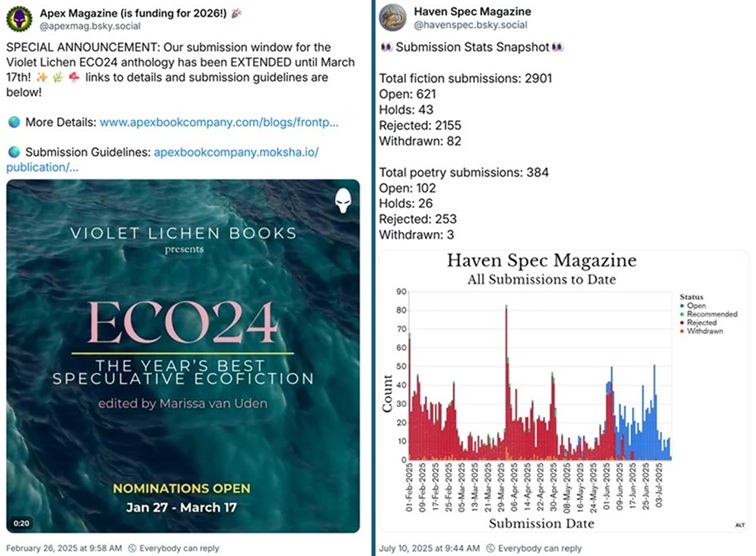
When it comes to topics that mean the most to you, controversial or otherwise, you may gain key insights about an editor’s thoughts, priorities, and processes from their social media posts, in addition to the information on their submissions webpage.
No matter how much or little time you have to devote to reading newsletters and industry news, using submissions trackers, and scrolling through social media posts, the information you gather could help you keep up with the shifting short SFFH market and better tailor your submission strategy to your personal priorities.
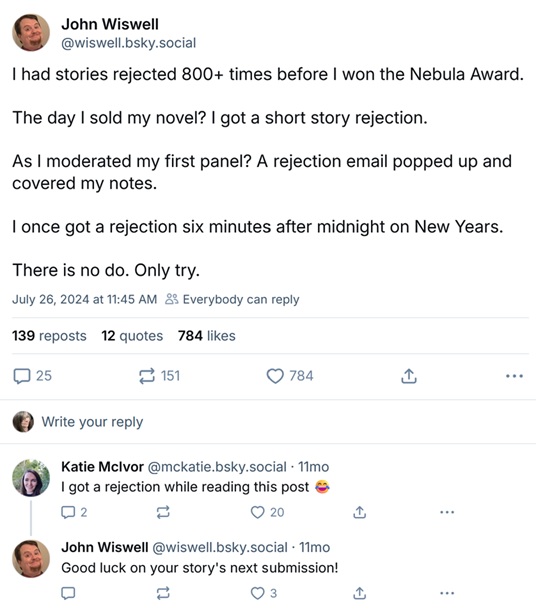
And after that, there’s nothing left but to submit, and submit, and submit again! Celebrate those rejections—each one means you’ve put your work out there. Rejections are just another part of the submissions game, after all—take it from John Wiswell and Katie McIvor:
Discover more from Odyssey Writing Workshops
Subscribe to get the latest posts sent to your email.