Interview: Graduate Sam W. Pisciotta
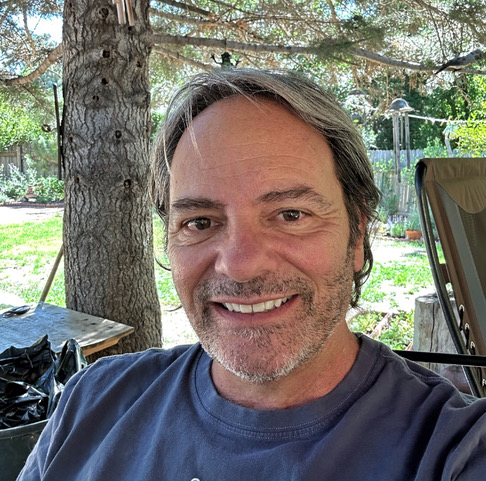
Sam W. Pisciotta is an intrepid storyteller hurtling through spacetime on the power of morning coffee and late-night tea. He writes stories for people who want to visit other planets, learn magic from birds, or camp in haunted forests. His M.A. in Literary Studies from the University of Colorado trained him to deconstruct a variety of texts; living life taught him how to put them back together. He loves holidays and birthdays, pints at the bar, and falling down the research rabbit hole. He would never choose the blue pill. Sam is a 2023 graduate of Your Personal Odyssey. He is a recipient of Odyssey’s Quantum Entanglement and Diverse Perspectives scholarships.
Can you talk about your pre-Odyssey writing process? What kind of writing schedule, if any, did you keep?
Before Odyssey, my writing process was a frantic over-grab for time. I didn’t schedule specific times to write, so I always felt guilty that I wasn’t accomplishing enough. This was partly true because I had no way of tracking my progress other than finished stories. Even though I was making decent headway, it never felt like enough, and that guilt mounted. After Odyssey, I began to schedule blocks of time dedicated to writing. I stick to these morning sessions nearly every day. Now, I can spend the rest of my day doing non-writing things without feeling guilty because I know that I wrote today. If I have time to write again tonight, that’s great. If not, I’ll write again tomorrow. Also, I write to a minimum daily word count and don’t consider a session complete until that minimum is met.
What made you decide to attend Your Personal Odyssey?
I’d heard a lot about various writing workshops within the speculative writing community—Clarion, Taos Toolbox, Viable Paradise, and of course Odyssey. The idea of focusing on my writing through workshopping appealed to me. I applied to Odyssey a couple of times before I was accepted, and by that time, the program had switched to Your Personal Odyssey. For me, this one-on-one structure is more productive and conducive to improvement. I can’t imagine that any other program could teach me more about writing.
How do you feel your writing and writing process changed as a result of having attended Your Personal Odyssey? What insights did you gain into your own work?
Working with Odyssey Director Jeanne Cavelos gave me greater insight into the aspects of my story—character development, worldbuilding, plot construction, and the other major elements that comprise narratives. I now have the knowledge and tools to look critically at those aspects in prewriting and during revision. One major change I made because of Odyssey was the time I spend developing a story before writing. I still like to leave room for exploratory writing, but I get a better story with fewer hours of editing when I use the prewriting techniques I learned with Jeanne. As silly as it sounds, I also struggled with constructing a logical plot based on the causal chain. Odyssey helped me address these plot hitches.
When and how did you make your first sale?
My first professional sale came before attending Odyssey. I submitted a flash piece to Analog and received an acceptance. Soon after I submitted stories to Fantasy & Science Fiction and Asimov’s that received acceptances. These pieces were flash or slightly longer. Early in my career, I had trouble selling longer pieces at the professional level, and that changed after Odyssey.
Your work is known for conveying powerful emotions, such as your latest short story, “Song of Nyx,” which came out in the January/February 2024 edition of Analog Science Fiction and Fact. How do you convey emotion in your work? Do you consider emotion as you write your first drafts, or do you layer in emotion in revisions?
I definitely consider emotion as I’m writing. In fact, the emotional foundation is probably laid down in the first draft more substantially than the plot. I work in vibes, I think, and if I’m not feeling emotions while I’m writing, then I know I need to change something. I use character as the base for my writing, and emotion seems to come out of building a strong character that I care about. I also tend to rely on resonance to create poignancy.
You’re also a visual artist, creating works using dry media and watercolor. Have you created visual art that then inspired you to write a story? How do you find that creating visual art helps with your fiction?
I find that the process moves in both directions. There have been times when my visual artwork has inspired a story. I also use visual art to help in my prewriting. Drawing can bring me into a creative space and turn off the editor. For most projects, particularly longer stories, I construct collages to help establish mood and theme. Likewise, after writing a story, I have sometimes been moved to create a visual representation; although, most often this is just sketchbook work.
What’s the biggest weakness in your writing these days, and how do you cope with it?
I have to guard against a breakdown of the causal chain within my plots. My answer to this is outlining, which I didn’t do earlier in my career. When I outline, I make sure that earlier events create the situation for later events to occur. This is something I worked on during Your Personal Odyssey, and I continue to focus on correcting it. At least now, I recognize the problem and I have the tools to fix it.
What’s next on the writing-related horizon? Are you starting any new projects?
I just finished the initial draft of my first novella. It felt great to set daily word-count goals and watch those add up to a completed longer work. I’m also working on my first science fiction novel, and it’s coming along nicely. I’m a believer in the power of daily words.
Discover more from Odyssey Writing Workshops
Subscribe to get the latest posts sent to your email.