Q&A Excerpt: Paul Park
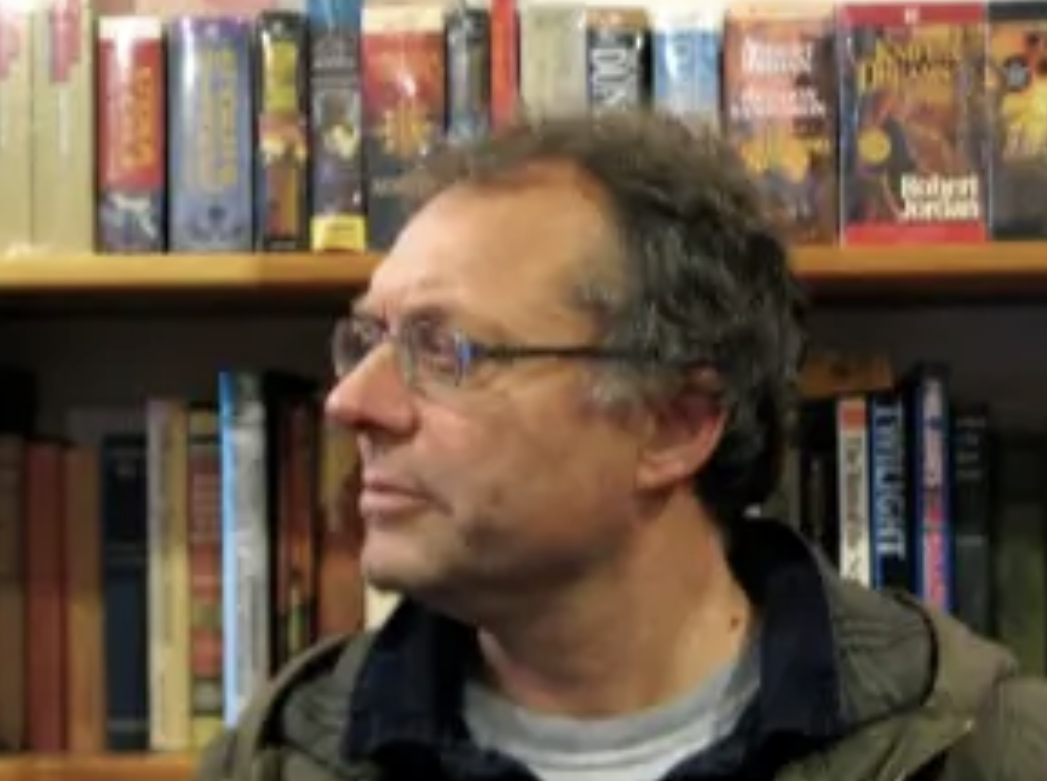
Paul Park was a 2024 guest lecturer for Your Personal Odyssey Writing Workshop. Paul is the author of A Princess of Roumania and numerous other novels. He published his first novel in the 1980s and swiftly attracted notice as one of the finest authors on the “humanist” wing of American SF. His powerful, densely written narratives of religious and existential crisis on worlds at once exotic and familiar won him comparisons with Gene Wolfe and Brian Aldiss at their best. His work has been nominated for the Nebula Award (twice), the World Fantasy Award (three times), the Arthur C. Clarke Award, the British Science Fiction Award, the James R. Tiptree Award (twice), the Sidewise Award for Alternate History (twice), the Locus Readers’ Award (twice), the Rhysling Poetry Award, the International Horror Guild Award, and the Theodore Sturgeon Award (twice). He lives in North Adams, Massachusetts.
In this excerpt transcribed from a question and answer session, Paul talks about point of view.
QUESTION: I was wondering about POV in relation to the revision process. Are there strategies to avoid some major pitfalls? Or is it something that you do later on?
PP: So every point of view that you choose—and you choose them to get at the material at hand, emotionally or practically in terms of information or describing context—you say, “Okay, this is the tool I want to use.” As always, the tool comes with things it can’t do, things it does well, things it does poorly, things that are impossible to do if you makethat choice.
I think the basic errors that people make with point of view, where you’re reading and all of a sudden you’re thrown into what you perceive as a point of view problem, are when you can see the writer panic and say, “Oh my God, I want to do this, but I can’t. I’ve sealed myself into this point of view where that’s not available to me. I’ve got a viewpoint character, and they don’t know X, so how do I show X?” And the skillful writer has to figure out a way of writing around that, bringing in that information.
This is probably the most basic way: If you’re in a first-person narration, let’s say it’s important to you to give a clear exterior sense of our viewpoint character as an object. How do you get that information to us? It’s a violation of point of view, or it feels incredibly hackneyed and stupid, if you do that directly. So you have to figure out ways of doing it indirectly.
So there’s all the problems in terms of the information you want to bring, or the exterior context you want, or the exposition, or anything like that—there are ways of solving all those problems in every point of view. But if you’re in a point of view that is not conducive to the obvious solution, you have to find unobvious ones, indirect ones, and if you go for the most direct ones, it’ll feel like an error. If you’re clearly in a character’s POV, and then sometimes you switch into somebody else’s character just to bring in information that otherwise you couldn’t get, that’ll feel like an error to us.
There’s a famous example I read when I was a kid. There was a potboiler novelist named Leon Uris, and he had written a long, thousand-page book about the IRA, essentially. And the way it started out was so very much a single viewpoint, first person, “this is a story I’ve written down for you” tone. The tone of it entirely was like, “Oh, in the spring of 1938 I did X, Y and Z.” And so you had a feeling of feet by the fire, somebody writing their memoirs, or something like that.
The end of the story, he’s attacking some British encampment or something like that, and bombs are going off, and you’re reading it and you’re thinking, “Well, jeez, things look bad for our hero, but luckily I know that he survives because of this voice that he’s established over a thousand pages.” But no. Pretty soon, a hand grenade comes rolling into this dugout where he is, and he’s like, “I knew I had to throw myself on this, to sacrifice myself so that my colleagues would live.” And you had this idiotic idea in your mind of somebody actually writing this down as the hand grenade is rolling toward him, going, “I only had ten seconds to live. No, now I only had five seconds to live. Here, take these pages and publish them while I throw myself on this hand grenade.” And that’s the end of the novel, and you think this is such a violation of point of view that it’s hard to take the entire thing seriously. The ending, this violent cataclysm that happens to character—it becomes farcical.
NOTE: This transcript has been edited for clarity.
Discover more from Odyssey Writing Workshops
Subscribe to get the latest posts sent to your email.