Interview: Graduate Shay Kauwe
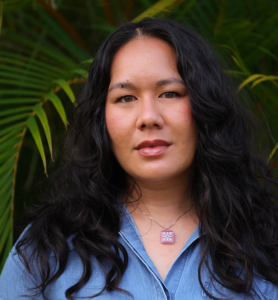
Shay Kauwe is a Your Personal Odyssey graduate and a Kanaka Maoli (Native Hawaiian) author from Hawaiʻi. She grew up on the Homestead in Waimānalo but moved to Russia because she fell in love with a boy. They now live on Oʻahu.
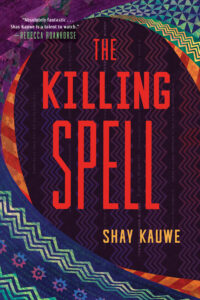
Shay holds an M.Ed in Education and was named an NCTE Early Educator of Color in 2021. In 2022, she was awarded an Empowering ʻŌiwi Leadership Award by the Hawaiian Council, for her work in storytelling and literacy. Her debut urban fantasy The Killing Spell (Saga/Solaris Books) is the first traditionally published adult fantasy novel by a Hawaiian author.
Shay Kauwe — Interviewed by Rebecca Roland
Can you talk about your pre-Odyssey writing process? What kind of writing schedule, if any, did you keep?
Pre-Odyssey, I didn’t have much of a writing process or schedule. I would write at odd hours, whenever the mood struck me, and though I plotted and kept notes on my manuscripts, they were very basic guides.
What made you decide to attend Your Personal Odyssey?
I decided to attend Your Personal Odyssey after finishing the first draft of my fourth manuscript and noticing that my work had plateaued. I saw a big jump in quality from my first book to the second, but in my third/fourth, I felt like there was this big gap in what I wanted this book to be and what it actually was. After some research, I found YPO and thought it was just what I needed to take my writing to the next level.
During YPO you met with and received detailed feedback from Odyssey Director Jeanne Cavelos and guest critiquers, critiqued pieces by Odyssey graduates, and had the opportunity to virtually attend lectures. What did you find the most helpful about the workshop?
Learning how to properly critique a manuscript was by far the most valuable part of YPO. I found that giving a critique can be just as beneficial to writing practice as receiving one, if you put the right intention and effort into it. Gaining that critical eye for writing has been invaluable.
Congratulations on the recent release of your debut novel, The Killing Spell, which is the first traditionally published adult fantasy novel by a Native Hawaiian. What was your inspiration for this novel? Did you begin with a character, worldbuilding, or an idea, and how did you blend these together into the final story?
Mahalo nui! I hadn’t thought much about writing process pre-YPO, but through the program and its deeper reflection, I learned that I may be one of the few writers who begins their books with theme! My process always starts with an ʻōlelo noʻeau, or Hawaiian proverb, as the central core, and I build the story around that.
The ʻōlelo noʻeau for The Killing Spell was “i ka ʻōlelo no ke ola; i ka ʻōlelo no ka make,” which roughly translates to “in language there is life; in language there is death.” The kaona, or deeper meaning, of this proverb is that languages are powerful, and thus revitilization is necessary to retain culture.
With this in mind, I moved on to worldbuilding and things naturally fell into place. If language was power, then a magic system in which language is literally magic just made sense—as did a main character who struggled with learning languages, including her indigenous tongue. In many ways, The Killing Spell is a reflection of issues that Native Hawaiians face today with language, land, and self-determination.
You’ve studied languages, including Russian and ‘Ōlelo Hawai’i, and The Killing Spell deals with the power of languages. How did your focus on languages affect your writing?
Most of the language-magic books I’ve read center around a character who is a genius at language learning, but in my experience, that tends to be pretty rare. In writing The Killing Spell, I wanted to explore the world through the eyes of someone who is not naturally talented with languages. This is really important when we discuss the study of indigenous languages because the shame of being “bad” at it is a huge barrier to revival. I strongly believe it’s imperative to try anyway and hope that this message shines through in The Killing Spell.
How many stages did The Killing Spell go through before you sent it off to a publisher? How much time did you spend writing the first draft, and how much time did you spend in revisions? What sort of revisions did you do?
The Killing Spell was rewritten top-to-bottom at least five times! (The consequence of not plotting beforehand, I fear.) The first draft came easy to me—a few months—but the revisions took three times as long. The second half of the book taking place on the Homestead is completely different from the original draft, which only happened in LA. This was a great idea, and I’m really glad we made that change! Other parts I pushed back on and got to keep, like maintaining my main character’s large family! I argued that it was central to her character and got to keep it as it was.
What’s next on the writing-related horizon? Are you starting any new projects?
My second book, House of Salt, is set to come out in 2027 with Saga! It’s a modern gothic set in Hawaiʻi, and I wasn’t sure that the genre-jump would get approved, so I’m super excited there were no issues with this. House of Salt is about con-woman pretending to be a Hawaiian kahuna, who has no qualms performing fake rituals to trick tourists out of their money, but when she’s invited to the estate of a wealthy hotel heiress to cleanse it of ghosts, she discovers that the evil lurking there is real.
I also am working on a YA dark academia and a Weird Western I finished while at YPO!
Discover more from Odyssey Writing Workshops
Subscribe to get the latest posts sent to your email.